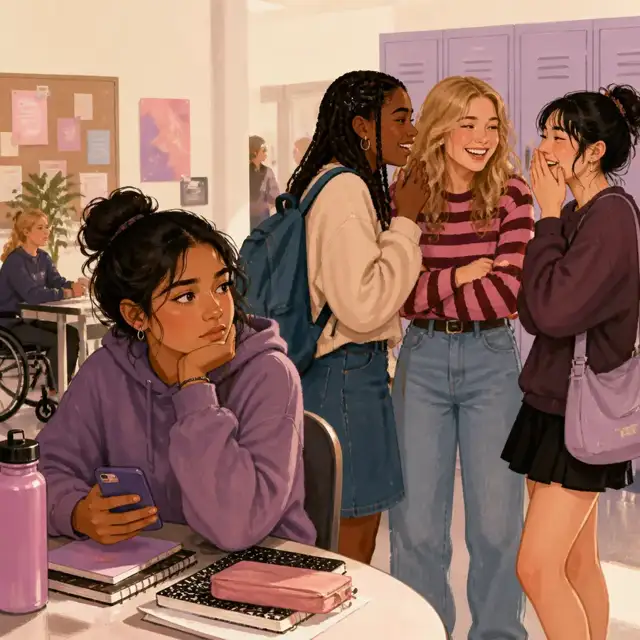
Surviving big girl-group friendships
Big friendship groups can be the best thing ever, and also completely exhausting. One day you're the favourite, the next there's an injoke you weren't part of, a group chat you got left out of, or two people who've suddenly gone quiet with you. None of this means you're unlikeable or that you're "too much." Group dynamics are genuinely complicated, and almost every girl has felt on the outside of her own friend group at some point, even the ones who look the most secure.
Sound like you?
Big friendship groups can be the best and the most exhausting thing all at once.
💜Group drama isn't proof you're unlikeable. Almost every girl has been on the outside of it.
Don't try to be best friends with everyone equally
Big groups feel less overwhelming when you have one or two people in them you're genuinely close to. You don't have to win the whole group's approval, you just need a couple of real connections inside it. Aim for depth with a few rather than constant approval from all.
Watch out for "triangulation"
That's when someone tells you what another friend "said about you" to stir things up, or makes it three against one. The healthiest move is almost always to go straight to the person it's about: "Hey, I heard this, is that actually true?" Drama loses its power the moment it's said out loud.
FOMO from the group chat isn't the full story
Seeing a photo of a hangout you weren't invited to genuinely stings. But people post the highlights, not the boring or awkward bits, and one missed invite isn't proof you're being pushed out. If it keeps happening, it's worth a calm, direct conversation rather than silent spiralling.
Refuse to be dragged into "pick a side"
When two friends fall out, you don't have to take sides or pass messages between them. "I love you both and I'm not getting in the middle" is a complete, mature answer. The people who respect it are showing you who your real friends are.
Know the difference between a rough patch and a onesided friendship
Good friendships have wobbles. But if you're always the one apologising, always the punchline, or only included when it suits them, that's not a rough patch, that's a friendship that's stopped being fair. It's okay to quietly step back and put your energy where it's returned.
You are allowed to step back from a group that costs you your peace. Leaving is not losing.
✨Try this
Next time the group drama spikes, take a 24 hour pause before replying to anything heated, especially in the chat. Screenshots and angry messages live forever and almost always make things worse. Talk it through with one person you trust first, then respond calmly, or in person, once the heat has dropped. Slowing down is a superpower in group friendships.
Why this actually helps
Big girl groups run on a mix of closeness and a little bit of competition, and that's normal, not a sign you've found "bad" friends. Knowing the patterns, triangulation, FOMO, side taking, means you can step back from the drama instead of getting swept up in it. The girls who feel calmest in groups aren't the most popular ones, they're the ones who don't outsource their whole self worth to the group.
Understand it
Big friendship groups can be the best and the most exhausting thing all at once.
You might notice:
- One day you're the favourite, the next you're frozen out with no explanation.
- You clock the group chat you weren't added to, or the joke you missed.
- There's a fake nice smile that somehow stings worse than a row would.
- You feel like you're 'too much' or 'not enough,' depending on the day.
- Start here if it feels right: Don't try to be best friends with everyone equally.
- Or give this a go: Watch out for "triangulation".
In real life
Group chats, falling outs, feeling left out and three against one drama. Here's how to keep your head and your kindness.
Things you can actually try:
- Don't try to be best friends with everyone equally: Big groups feel less overwhelming when you have one or two people in them you're genuinely close to.
- Watch out for "triangulation": That's when someone tells you what another friend "said about you" to stir things up, or makes it three against one.
- FOMO from the group chat isn't the full story: Seeing a photo of a hangout you weren't invited to genuinely stings.
- Refuse to be dragged into "pick a side": When two friends fall out, you don't have to take sides or pass messages between them.
- Know the difference between a rough patch and a onesided friendship: Good friendships have wobbles.
- Tell one safe person what is going on, even if you only know how to say, ‘I need some help.’