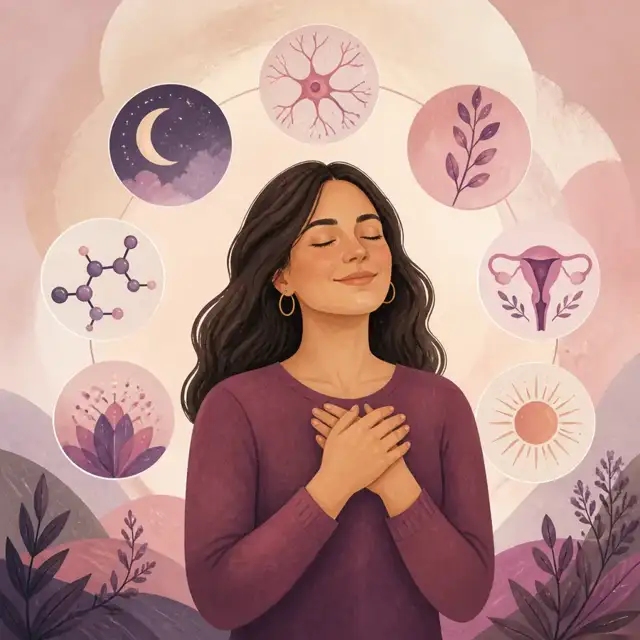
Your hormones, explained, and how each one moves your mood
Hormones are chemical messengers. They are made in one part of your body, travel in your blood, and tell other parts what to do, including your brain. That last part is the bit almost nobody explains, and it is the reason your mood can genuinely change from week to week without anything in your life changing at all. This guide goes through the main hormones one at a time, what each does, and what it feels like when it rises and falls. If you want the practical, lifestyle side of keeping them steadier, the hormone balance guide above covers that.
Sound like you?
If your mood follows a pattern you can almost predict but never explain, this is worth reading.
💜Hormones are not an excuse and they are not all in your head. They are physiology, and knowing the pattern gives you something to work with.
Oestrogen: the one that lifts you
Oestrogen rises in the first half of your cycle and does far more than fertility. It interacts with the serotonin and dopamine systems, which is thought to be part of why higher oestrogen days often come with better mood, more confidence, sharper memory and more sociability. The flip side matters just as much: it is the drop in oestrogen, rather than a low level on its own, that most reliably triggers low mood, tearfulness, migraine and irritability. That drop happens just before your period, after birth, and repeatedly through perimenopause.
Progesterone: the one that calms, or flattens
Progesterone rises after ovulation. Your body converts some of it into allopregnanolone, which acts on the same brain receptors as alcohol and sedatives. For many people that means calm, sleepiness and a slower pace. For others, especially anyone sensitive to it, the same chemistry produces the opposite: anxiety, low mood, restlessness and a short fuse. Both reactions are normal and known, so if the second half of your cycle is consistently the hard half, this is usually why.
Testosterone: drive, focus and libido
Yes, you make testosterone too, in your ovaries and adrenal glands, and it matters. It contributes to motivation, assertiveness, muscle strength, mental drive and libido. It peaks around ovulation and declines gradually from your late twenties onward. Levels that are too high, as in PCOS, cause acne, unwanted hair growth and hair thinning; levels that fall away, as in perimenopause or after some surgeries, tend to show up as flatness, low libido and a loss of get-up-and-go.
Cortisol: the one that overrides everything else
Cortisol is your stress hormone, and it sits at the top of the pile. When it is chronically high your body deprioritises reproduction, so cortisol can delay ovulation, lengthen or skip cycles, and make every other hormonal symptom worse. It also directly disrupts sleep, which then worsens mood on its own. This is the honest reason why “just reduce your stress” keeps coming up: cortisol is the one hormone your daily habits genuinely move.
Knowing why you feel the way you feel does not make you fragile. It makes you fluent in your own language.
How this plays out across a whole cycle, and a whole life
Roughly, counting day 1 as the first day of proper bleeding. Cycle lengths vary a lot, so treat these as a shape rather than a timetable.
Days 1 to 7, your period: low everything
Both oestrogen and progesterone are at their lowest. Energy is usually low, and prostaglandins (the chemicals that make your womb cramp) also cause the nausea, loose bowels and headaches that can come with it. Many people notice a real lift in mood by around day 3 or 4 even while still bleeding, because oestrogen has started climbing again.
Days 7 to 14, follicular and ovulation: rising
Oestrogen climbs steadily and testosterone peaks near ovulation. This is, for most people, the best week: more energy, more confidence, better concentration, higher libido, more willingness to do hard things. If you have any choice over when you schedule demanding work, difficult conversations or anything needing nerve, this is the window.
Days 15 to 28, the luteal phase: progesterone, then the drop
Progesterone dominates. Early on that often feels steady or sleepy. In the final few days before your period both hormones fall sharply, and that withdrawal is what produces classic PMS: irritability, tearfulness, anxiety, sugar cravings, sore breasts, bloating, poor sleep. It typically eases within a day or two of bleeding starting.
When PMS is actually PMDD
If the low mood in those luteal days is severe rather than annoying, hopelessness, rage, feeling unable to function, or thoughts of self-harm, and it reliably disappears once your period starts, that pattern has a name: premenstrual dysphoric disorder. It affects a small but significant number of people, it is recognised in UK guidelines, and it is treatable. Tracking symptoms daily across two cycles is exactly the evidence a GP needs, and it is worth asking about specifically rather than being managed as general depression.
Perimenopause: the years of unpredictable oestrogen
Perimenopause usually begins in the forties, sometimes the late thirties, and can last several years before periods stop. The defining feature is not low oestrogen but erratic oestrogen, sharp peaks and sharp drops. Because it is the drop that hits mood, this stage often arrives first as anxiety, rage, brain fog, poor sleep and a feeling of not being yourself, sometimes long before any change in periods or any hot flush. It is very commonly mistaken for burnout or depression.
Thyroid hormones, the ones everyone forgets
Your thyroid sets your whole metabolic pace, and an underactive one looks almost exactly like depression: exhaustion, low mood, weight gain, brain fog, feeling cold, heavy periods. It is a simple blood test, and it is genuinely worth ruling out before accepting that how you feel is purely psychological. The Hashimoto's guide below covers the autoimmune version in detail.
🧰Your hormones and mood tool kit
✨Try this: map one cycle
This takes about thirty seconds a day and gives you something concrete instead of a hunch:
- Each evening, rate your mood, energy and sleep out of five. Three numbers, nothing else.
- Note day 1 of your period each month so the numbers line up against your cycle.
- After two cycles, look at where the low scores sit. Bunched in the week before bleeding? That is a hormonal pattern, not a character flaw.
- If the low days are severe, take the chart to your GP and ask directly about PMDD or, if you are in your late thirties or forties, about perimenopause.
Going deeper: the cycle as a month of different chemistry
Most of us were taught the cycle as a bleeding schedule. Understanding it as four distinct hormonal environments explains far more about your mood, energy and patience than a date in a diary ever could.
Two hormones, rising and falling on different schedules
A cycle is usually counted from the first day of bleeding. In the first half, the follicular phase, oestrogen climbs steadily as an egg matures. Oestrogen is not only a reproductive hormone: it interacts with serotonin and dopamine systems in the brain, tends to support verbal fluency and mood, and is part of why many people feel sharper and more sociable as it rises.
Ovulation sits in the middle, and afterwards the picture changes completely. The structure left behind produces progesterone, which dominates the second half, the luteal phase. Progesterone is calming for some people and flattening for others, raises body temperature slightly, and can disturb sleep. If no pregnancy occurs, both hormones drop away sharply in the last few days, and that withdrawal, rather than any high level, is what most premenstrual symptoms track.
Why the drop matters more than the level
This is the single most useful thing to understand here. Premenstrual symptoms are not generally caused by too much or too little of a hormone. They are a response to change, specifically to the rapid withdrawal of oestrogen and progesterone in the last few days of the cycle. Some brains are considerably more sensitive to that withdrawal than others, which is why two people with identical hormone levels can have entirely different premenstrual experiences.
That explains something that otherwise looks like a character flaw. If your mood reliably falls off a cliff four days before bleeding and lifts within a day of starting, you are not inconsistent or dramatic. You are sensitive to a chemical change that is genuinely happening, on a schedule that can be predicted and therefore planned around.
The other hormones in the room
Oestrogen and progesterone get the attention, but they are not working alone. Testosterone, present in smaller amounts, contributes to drive, confidence and libido, and often peaks around ovulation. Cortisol, the main stress hormone, interacts with the whole system: sustained stress can delay or suppress ovulation, which is why a brutal month at work can shift a cycle. Thyroid hormone sets the background metabolic pace and can change bleeding patterns when it drifts.
Then there is the least discussed interaction of all, the effect of cycle hormones on the brain systems that govern attention and motivation. Falling oestrogen in the second half of the cycle appears to reduce the effect of dopamine, which is part of why focus and motivation can noticeably drop premenstrually, and why this hits particularly hard for people with ADHD.
The words worth knowing
Three things worth correcting
How to turn this into something useful
Track for two or three cycles before drawing conclusions, and record how you felt rather than only when you bled. Three quick daily numbers out of five, mood, energy and sleep, plus a word about pain, is enough. One cycle tells you almost nothing because life is noisy; three cycles reveal whether the bad days are landing in the same phase every time, which is exactly the evidence a GP needs and exactly what you cannot reconstruct from memory.
Then use the pattern rather than just observing it. Where you have any choice, put demanding work, difficult conversations and new commitments in the phase where you reliably have more capacity, and protect the days you reliably do not. This is not lowering your standards. It is the same principle as not scheduling a presentation for the morning after a night flight, applied to information about your own body that only you have.
Why this matters
Being told “it's just your hormones” is dismissive. Understanding which hormone, when, and why is the opposite: it is information you can act on. It stops you reading a predictable four-day dip as evidence that your life is falling apart or that you have failed at healing, and it lets you plan rest and lighten your load around the days you already know will be harder. Nothing about this means your feelings are not real. It means they have a rhythm, and rhythms can be worked with.
Understand it
Cycle-related mood changes are real, but severity matters. PMS symptoms occur before a period and usually improve after it starts; symptoms that seriously disrupt work, relationships or safety may need assessment for PMDD or another condition rather than more self-discipline.
You might also notice:
- There are days in the month you genuinely do not like yourself, and then it lifts.
- Your brain feels sharp one week and full of cotton wool the next.
- Small things flatten you for a few days, then stop mattering.
- Someone has told you it is “just hormones” in a way that made you feel dismissed.
- A gentle place to start: Oestrogen: the one that lifts you.
- Another thing worth trying: Progesterone: the one that calms, or flattens.
In real life
You are not “a different person for no reason” if irritability, despair or anxiety arrives in the same cycle window. Tracking dates, intensity, sleep and bleeding can reveal a pattern worth taking to a clinician.
Other ways this can show up:
- Small things flatten you for a few days, then stop mattering.
- Someone has told you it is “just hormones” in a way that made you feel dismissed.
- There are days in the month you genuinely do not like yourself, and then it lifts.
- Your brain feels sharp one week and full of cotton wool the next.
- One small thing to try: Testosterone: drive, focus and libido.
- You might also try: Cortisol: the one that overrides everything else.