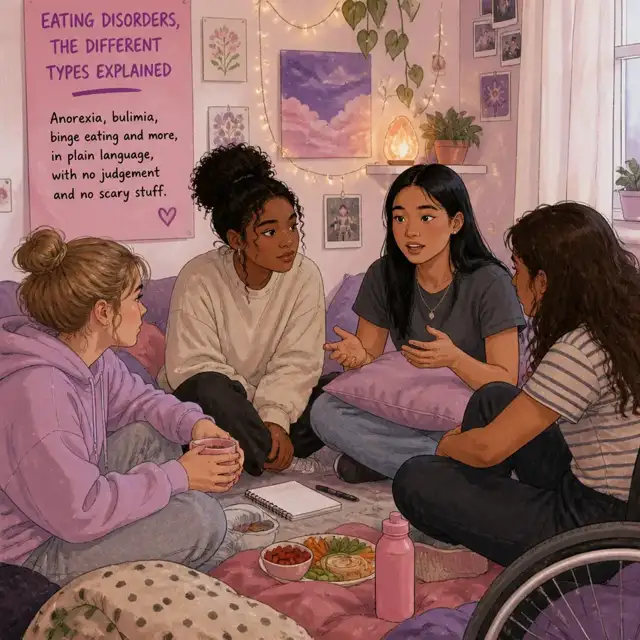
Eating disorders, the different types explained
An eating disorder is a serious but treatable mental health condition, not a lifestyle choice, a phase, or a failure of willpower. They're really about using food, eating, or not eating to cope with difficult feelings, and they come in several different forms. You can have one at any weight, any size, and any gender, you can't tell someone has an eating disorder just by looking at them. Knowing the different types can help you understand yourself or a friend, and there's no shame in any of it.
Why you might be reading this
Maybe you're trying to make sense of something, for yourself, or for someone you care about.
💜Understanding it is never a betrayal. It's often the very first step toward things getting better.
Anorexia nervosa
Severely limiting food, often alongside an intense fear of gaining weight and seeing your body differently from how it really is. It can include eating tiny amounts, cutting out whole food groups, or exercising to "burn off" everything eaten. It's dangerous for the body even when someone doesn't look very thin.
Bulimia nervosa
A cycle of eating a large amount of food in one go (a binge) and then trying to "undo" it, by vomiting, using laxatives, fasting, or overexercising. It's often hidden and comes with a lot of secrecy and shame. People with bulimia are frequently an "average" weight, which is part of why it goes unnoticed.
Binge eating disorder (BED)
Regularly eating very large amounts of food, often quickly and past the point of comfort, while feeling out of control and distressed, but without the "undoing" behaviours of bulimia. It's the most common eating disorder, and it's frequently driven by using food to numb difficult emotions, not by "greed."
ARFID (avoidant/restrictive food intake disorder)
Avoiding or restricting food, but not because of worries about weight or body shape. It can be about textures, smells, fear of choking or being sick, or simply very little interest in eating. It's more common in neurodivergent people, including those with autism or ADHD.
OSFED (other specified feeding or eating disorder)
This is the term used when someone's eating disorder is serious and real but doesn't tick every box of the others, for example bulimia type behaviours that happen less often. OSFED is actually one of the most common diagnoses, and it's just as deserving of support, not a "lesser" version.
Orthorexia (and disordered eating generally)
Orthorexia isn't an official diagnosis yet, but it describes an unhealthy obsession with "clean" or "pure" eating that takes over your life. More broadly, "disordered eating", strict rules, guilt around food, skipping meals, food ruling your thoughts, can be serious even without a formal label. You don't have to be "bad enough" to deserve help.
Understanding something takes away its power to stay a secret, and secrecy is what lets this grow.
🧰Warning signs worth noticing
💬How to open up about it
Whether it's about you or a friend, you don't need clinical words. Honest and simple is enough.
Why this actually helps
Eating disorders get more entrenched the longer they go untreated, and they get easier to recover from the sooner someone reaches out, so naming what's happening is genuinely powerful. They are not about vanity or attention; they're a way the mind tries to cope, and with the right support people recover fully all the time. Whatever type fits, or even if none of them fit perfectly, your struggle is real and you deserve help.
Understand it
Maybe you're trying to make sense of something, for yourself, or for someone you care about.
You might notice:
- You're wondering if what you, or a friend, are doing actually has a name.
- You assumed eating disorders 'look' a certain way and aren't sure yours counts.
- Your relationship with food feels controlling, exhausting, or frightening.
- You just want to understand what's going on, with zero shame attached.
- Start here if it feels right: Anorexia nervosa.
- Or give this a go: Bulimia nervosa.
In real life
Anorexia, bulimia, binge eating and more, in plain language, with no judgement and no scary stuff.
Things you can actually try:
- Anorexia nervosa: Severely limiting food, often alongside an intense fear of gaining weight and seeing your body differently from how it really is.
- Bulimia nervosa: A cycle of eating a large amount of food in one go (a binge) and then trying to "undo" it, by vomiting, using laxatives, fasting, or overexercising.
- Binge eating disorder (BED): Regularly eating very large amounts of food, often quickly and past the point of comfort, while feeling out of control and distressed, but without the "undoing" behaviours of bulimia.
- ARFID (avoidant/restrictive food intake disorder): Avoiding or restricting food, but not because of worries about weight or body shape.
- OSFED (other specified feeding or eating disorder): This is the term used when someone's eating disorder is serious and real but doesn't tick every box of the others, for example bulimia type behaviours that happen less often.
- Orthorexia (and disordered eating generally): Orthorexia isn't an official diagnosis yet, but it describes an unhealthy obsession with "clean" or "pure" eating that takes over your life.