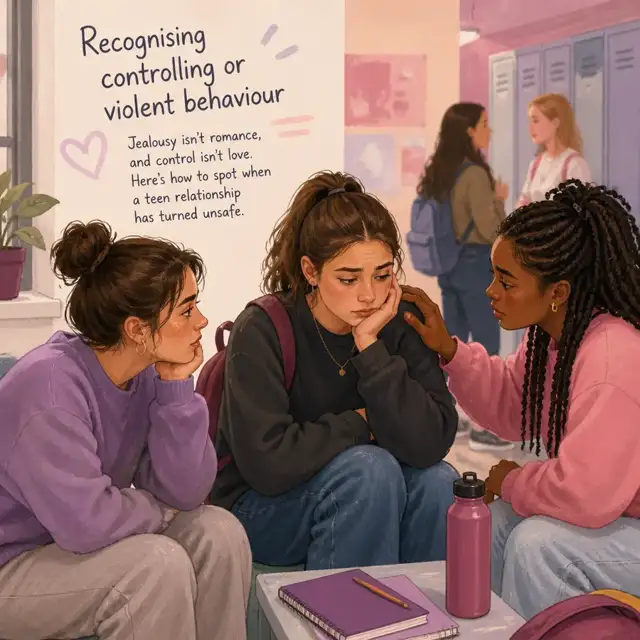
Recognising controlling or violent behaviour
A relationship is meant to make your world feel bigger, not smaller. Controlling and abusive behaviour can grow so gradually that it gets normalised, and it's often dressed up as "caring so much." Abuse isn't only hitting, it can be emotional, sexual, financial, or online, and it can happen in any relationship, whatever your gender or theirs. Reading this doesn't mean you've done anything wrong. It just means part of you already senses something is off, and that part of you is worth listening to.
Sound like you?
A good relationship makes your world feel bigger. Control makes it shrink, slowly and quietly.
💜Noticing this doesn't mean you did anything wrong. It means part of you already knows.
They control where you go and who you see
Checking your location, deciding what you wear, getting angry when you spend time with friends or family, or needing to know where you are at all times. This is dressed up as "I just love you so much", but it's control. Love trusts; it doesn't monitor.
Jealousy is treated as proof of love
Accusing you of cheating, going through your phone, demanding your passwords, or losing it when you reply "too slowly." Intense jealousy isn't flattering or romantic, it's a warning sign, and it tends to get worse, not better, over time.
You feel scared of how they'll react
If you find yourself softening your words, hiding things, or planning around their moods to avoid an explosion, that fear is the clearest sign of all. You should never have to manage someone else's temper to keep yourself safe.
There's any physical force, ever
Grabbing, pushing, blocking a doorway, throwing things, "play" fighting that hurts, or any unwanted physical contact, none of it is okay, not even once, not even if they cry and apologise afterwards. The apology then repeat cycle is part of how abuse works.
They pressure you sexually
Guilt tripping, threatening to leave, sharing or threatening to share private photos, or ignoring it when you say no or "not yet." You never owe anyone your body to prove you care. Consent has to be freely given every single time, and it can be taken back at any point.
The "sorry" never actually changes anything
Big apologies, gifts, and promises after a bad incident, followed by the same behaviour weeks later, is a recognised cycle. If the pattern keeps repeating, believe the pattern, not the promises.
Love does not need to frighten you to be real. Feeling safe is the bare minimum, not a bonus.
🧰Where to get help
💬How to tell someone what's happening
You don't need the perfect words or the full story. Starting the sentence is the brave bit, the person you tell will help with the rest.
Why this actually helps
Abuse thrives in silence and self blame, so naming it is a genuine act of strength, not weakness. You are not responsible for someone else's behaviour, you can't "love them better" out of it, and leaving an unsafe relationship is not giving up, it's protecting yourself. Plenty of people have been exactly where you are and gone on to be safe and happy. You can too.
Understand it
A good relationship makes your world feel bigger. Control makes it shrink, slowly and quietly.
You might notice:
- They want to know where you are and who you're with, constantly.
- Your world's got smaller, you barely see your friends or family now.
- You change how you act to avoid setting them off.
- It's sold as 'caring so much,' but it makes you feel trapped, not loved.
- Start here if it feels right: They control where you go and who you see.
- Or give this a go: Jealousy is treated as proof of love.
In real life
Jealousy isn't romance, and control isn't love. Here's how to spot when a teen relationship has turned unsafe.
Things you can actually try:
- They control where you go and who you see: Checking your location, deciding what you wear, getting angry when you spend time with friends or family, or needing to know where you are at all times.
- Jealousy is treated as proof of love: Accusing you of cheating, going through your phone, demanding your passwords, or losing it when you reply "too slowly." Intense jealousy isn't flattering or romantic, it's a warning sign, and it tends to get worse, not better, over time.
- You feel scared of how they'll react: If you find yourself softening your words, hiding things, or planning around their moods to avoid an explosion, that fear is the clearest sign of all.
- There's any physical force, ever: Grabbing, pushing, blocking a doorway, throwing things, "play" fighting that hurts, or any unwanted physical contact, none of it is okay, not even once, not even if they cry and apologise afterwards.
- They pressure you sexually: Guilt tripping, threatening to leave, sharing or threatening to share private photos, or ignoring it when you say no or "not yet." You never owe anyone your body to prove you care.
- The "sorry" never actually changes anything: Big apologies, gifts, and promises after a bad incident, followed by the same behaviour weeks later, is a recognised cycle.