Understanding anxiety and how to calm it
Anxiety is that horrible mix of a racing heart, churning stomach, racing thoughts and a feeling that something bad is about to happen, even when nothing actually is. Here's the thing nobody tells you: anxiety isn't a sign that you're broken or weak. It's your body's alarm system doing its job a little too well, trying to protect you from danger that isn't really there. It can be turned down, and you can learn how. This guide explains what's going on inside you and gives you simple, real things to do when it hits.
Sound like you?
Anxiety is sneaky, it often shows up as everyday stuff you didn't even label as 'anxiety.'
💜This isn't you being 'weak' or 'dramatic.' It's an alarm system stuck on, and it can be turned down.
What anxiety actually is
Deep in your brain there's a tiny alarm called the amygdala. Its only job is to keep you safe, and when it senses a "threat" (a test, a text left on read, a room full of people) it floods your body with adrenaline to get you ready to fight or run. That's why your heart pounds, your hands shake, your tummy flips and your thoughts speed up. None of it means you're in danger, it just means your alarm is sensitive. Knowing this is step one, because a feeling you understand is far less frightening than one you don't.
Name it to tame it
When the wave hits, say to yourself (out loud or in your head): "This is anxiety. It's uncomfortable, but it's not dangerous, and it will pass." Putting a name to the feeling actually calms the alarm part of your brain and switches on the thinking part. You're not trying to make it disappear instantly, you're just reminding yourself that you've felt this before and survived it every single time.
Breathe out for longer than you breathe in
This is the fastest way to switch off the alarm. When you make your out breath longer than your in breath, you tell your nervous system "the danger's over, you can stand down." Try breathing in through your nose for 4, then slowly out through your mouth for 6 or 7, like you're gently blowing through a straw. Do it for one minute. Your heart rate will start to drop on its own, you don't have to force calm, the breathing does it for you.
Get back into your body with your senses
Anxiety lives in the future ("what if…"). Your senses live in right now, and right now you're safe. Try the 54321 trick: look around and name 5 things you can see, 4 you can hear, 3 you can touch, 2 you can smell, and 1 you can taste. Cold water on your wrists or face works brilliantly too. It sounds too simple to work, but it physically pulls your brain out of the spiral and back into the present moment.
Question the scary thought
Anxiety is a brilliant storyteller and a terrible fortune teller. It says "everyone will laugh," "I'm going to fail," "something's wrong with me." Catch the thought and ask: Is this a fact, or a fear? What's actually most likely to happen? What would I say to a friend thinking this? You don't have to win an argument with your anxiety, just loosen its grip enough to see it's a feeling, not a forecast.
Shrink it over time, don't avoid it
Avoiding the things that scare you feels good for about five minutes, then it makes the anxiety bigger, because your brain never gets to learn "actually, that was okay." Facing things in small, doable steps teaches your alarm to stop firing. Cut down on energy drinks and too much caffeine (they mimic anxiety in the body), move your body most days, get decent sleep, and go easy on the endless scrolling, which feeds comparison and worry. Small habits quietly lower your baseline so the spikes get smaller.
Anxiety lies with confidence. You are allowed to hear it and not believe it.
💬What to say
Telling someone takes the power out of anxiety, you don't have to carry it alone.
✨Try this: the 60 second reset
Next time you feel the wave building, do these three things in order, it takes about a minute. First, plant both feet flat on the floor and feel the ground holding you. Second, breathe in for 4 and out for 7, four times. Third, name out loud one thing you can see and one thing you can hear. That's it. You've just spoken to your nervous system in the only language it understands, and told it you're safe.
Why this actually helps
You can't always stop anxiety from showing up, but you can absolutely change what happens next. Every time you breathe through a wave instead of running from it, you teach your brain that it's safe, and the alarm gets a little quieter the next time. This isn't about never feeling anxious again, even the calmest people feel it. It's about knowing the feeling can't actually hurt you, having a few tools in your pocket, and trusting that it always, always passes.
Understand it
Anxiety is sneaky, it often shows up as everyday stuff you didn't even label as 'anxiety.'
You might notice:
- You've started 'feeling ill' on Sunday nights or Monday mornings to dodge school.
- Your heart races and your thoughts spiral over things that haven't even happened.
- You reread a text ten times, certain you've said something wrong.
- You skip things you actually want to do because the worry feels too big.
- Start here if it feels right: What anxiety actually is.
- Or give this a go: Name it to tame it.
In real life
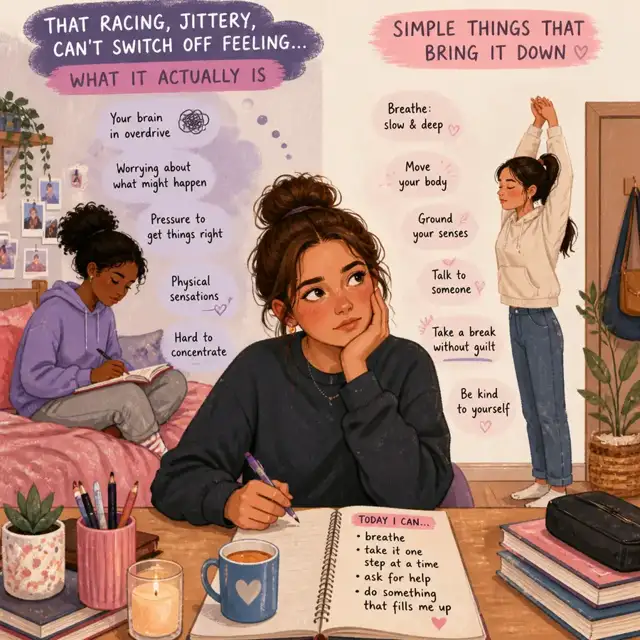
That racing, jittery, can't switch off feeling, what it actually is, and simple things that bring it down.
Things you can actually try:
- What anxiety actually is: Deep in your brain there's a tiny alarm called the amygdala.
- Name it to tame it: When the wave hits, say to yourself (out loud or in your head): "This is anxiety.
- Breathe out for longer than you breathe in: This is the fastest way to switch off the alarm.
- Get back into your body with your senses: Anxiety lives in the future ("what if…").
- Question the scary thought: Anxiety is a brilliant storyteller and a terrible fortune teller.
- Shrink it over time, don't avoid it: Avoiding the things that scare you feels good for about five minutes, then it makes the anxiety bigger, because your brain never gets to learn "actually, that was okay." Facing things in small, doable steps teaches your alarm to stop firing.