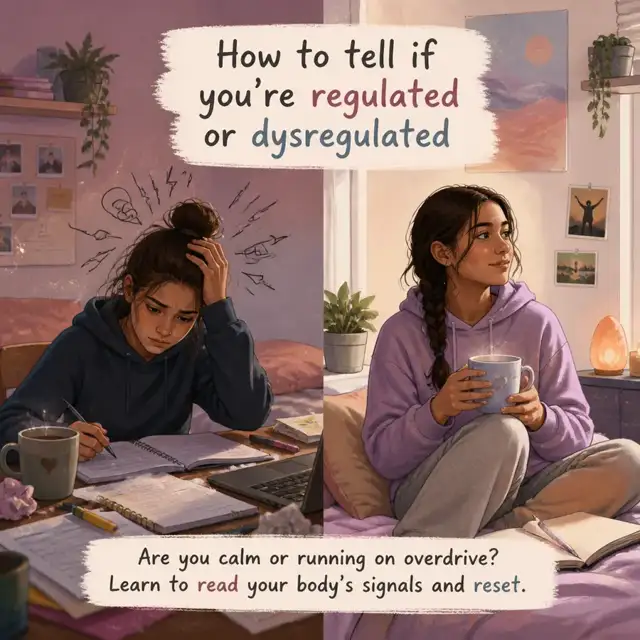
How to tell if you're regulated or dysregulated
Okay, this one's actually a game changer once you get it. So much of feeling "off" comes down to whether your nervous system feels safe or feels like it's under attack, even when literally nothing dangerous is happening. Once you can spot the difference, you can do something about it way faster.
Sound like you?
Your nervous system is basically your body's smoke alarm, and sometimes it goes off over toast.
💜Once you can read the signals, you stop fighting your body and start working with it.
This is what regulated feels like
Calm but switched on, able to actually think straight, able to chat to people normally, able to move from one thing to the next without spiralling. Your breathing is steady, your body just feels okay.
This is what dysregulated feels like in your body
Heart racing, jaw or chest tight, stomach doing weird things, feeling "buzzy but exhausted" at the same time, or the total opposite, going numb and flat. Your body usually clocks it before your brain does.
And this is what it looks like in your mood and thoughts
Snapping at people over nothing, totally overreacting to a small thing, brain fog, struggling to focus, or worrying about something way out of proportion to what's actually going on.
Work out your own pattern
Some people get loud and reactive when they're dysregulated, others go quiet and shut down. There's no wrong version, but knowing yours means you can catch it earlier next time, before it gets big.
Use the vagus nerve tricks above to get back to calm
Once you notice you're dysregulated, the tools in the Vagus Nerve guide on this page, slow breathing, cold water, humming, a tight hug, are literally designed to bring your body back to that calmer place.
Big reactions do not make you dramatic. They make you human, and with practice they get easier to soften.
Catching it earlier
The earlier you spot dysregulation, the easier it is to turn around. These build that early warning radar.
Learn your "window of tolerance"
Picture a window: inside it you're regulated and coping. Pushed too high (panic, rage, overwhelm) you go above it; pushed too low (numb, flat, frozen) you drop below it. The goal isn't to never leave the window, it's to notice when you have, and gently come back.
Match the tool to the state
If you're over the window (buzzing, panicky), you need calming tools, slow breathing, cold water. If you're under it (numb, shut down), you need gently energising ones, movement, music, stepping outside. Using the wrong one is why "just breathe" sometimes doesn't help.
🧰Your check in tool kit
✨Try this body check in
Right now, scan from head to toe and answer three quick questions:
- Where's my breath? High and fast, or low and slow?
- What's tight? Jaw, shoulders, stomach, fists?
- Am I over or under my window? Buzzing, or numb?
Then pick one matching tool. Doing this a few times a day trains you to notice dysregulation before it becomes a meltdown.
Why this actually matters
Your nervous system decides how safe you feel before your brain even catches up, which is exactly why a bad mood can feel like it came from nowhere. Spotting the early, quiet signs, the tight shoulders, the racing thoughts, means you get a chance to handle it before it turns into a full meltdown moment.
Understand it
Your nervous system is basically your body's smoke alarm, and sometimes it goes off over toast.
You might notice:
- Your body flips into panic mode over stuff that isn't actually dangerous.
- Sometimes you go numb or shut down and can't explain why.
- You swing from wired to completely wiped out with not much in between.
- You react big, then think where did that even come from?
- Start here if it feels right: This is what regulated feels like.
- Or give this a go: This is what dysregulated feels like in your body.
In real life
Are you calm or running on overdrive? Learn to read your body's signals and reset.
Things you can actually try:
- This is what regulated feels like: Calm but switched on, able to actually think straight, able to chat to people normally, able to move from one thing to the next without spiralling.
- This is what dysregulated feels like in your body: Heart racing, jaw or chest tight, stomach doing weird things, feeling "buzzy but exhausted" at the same time, or the total opposite, going numb and flat.
- And this is what it looks like in your mood and thoughts: Snapping at people over nothing, totally overreacting to a small thing, brain fog, struggling to focus, or worrying about something way out of proportion to what's actually going on.
- Work out your own pattern: Some people get loud and reactive when they're dysregulated, others go quiet and shut down.
- Use the vagus nerve tricks above to get back to calm: Once you notice you're dysregulated, the tools in the Vagus Nerve guide on this page, slow breathing, cold water, humming, a tight hug, are literally designed to bring your body back to that calmer place.
- Learn your "window of tolerance": Picture a window: inside it you're regulated and coping.